
Salida 8: a Punishment for Chilean Football
At Santiago's National Stadium, a preserved stand recalls the moment football, dictatorship and trauma shared the same ground.
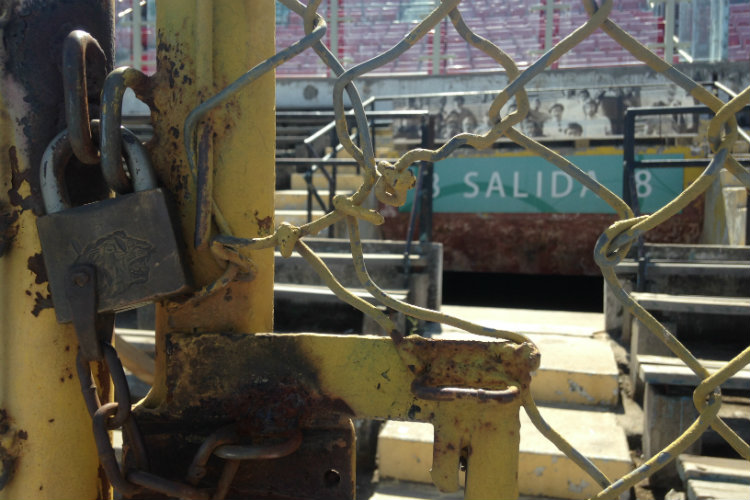
Challenge
Santiago's National Stadium occupies a singular place in Chilean history: it is both the country's main sporting stage and one of the most traumatic symbols of the repression that followed the September 11, 1973 coup. During the first months of Augusto Pinochet's dictatorship, thousands of political prisoners were held inside the complex, which at the same time remained tied to Chile's national team and qualification for the 1974 World Cup.
The challenge of the story was to address that overlap without reducing it to a historical football curiosity. It required reconstructing the stadium's role in the repressive apparatus, showing how that memory remains physically inscribed in the space and connecting political trauma with the sporting episode later known for Chile's “ghost goal” against the Soviet Union.
Solution
The feature was built around a visit to the section known as Salida 8 — or Hatch No. 8 — and an interview with Manuel Méndez, a former political prisoner who decades later worked there as a volunteer guide. His testimony provides the human axis of the story: his imprisonment in 1973, hundreds of detainees sharing confined spaces, marks left on the walls and the psychological consequences that remained throughout his life.
From that individual experience, I broadened the story with historical research and data from Chile's Museum of Memory and Human Rights, linking repression inside the stadium to qualification for the 1974 World Cup. The Soviet Union's refusal to play the return leg there, and FIFA's decision to keep the venue, produced one of the clearest symbols of the relationship between football and dictatorship: Chile entered the pitch alone and scored the goal that confirmed its qualification.
Impact
The result is a feature that uses football as an entry point into a larger story about memory, authoritarianism and human rights. The National Stadium stops functioning merely as a sporting venue and becomes a space where different layers of Chilean history remain physically superimposed.
Within my portfolio, this is one of the stories that best represents the international and field-reporting side of my journalistic background. The work combines travel, direct observation, interviewing, historical research and sport to produce a public-interest narrative that goes well beyond the result of a match or the career of a single figure.
My role
I reported the story in Santiago, visited and documented the preserved section of the National Stadium, interviewed Manuel Méndez and researched the historical context and data used in the feature. I was responsible for the reporting, writing and narrative structure.
Reporting angles
Field reporting in Chile
The reporting was carried out at Santiago's National Stadium, including a visit to the preserved Salida 8 section.
A former political prisoner's memory
Manuel Méndez's testimony connects the institutional history of the dictatorship to the personal experience of imprisonment.
Football and dictatorship
The feature reconstructs the 1974 World Cup qualifier in which the Soviet Union refused to play at a stadium being used as a center of repression.
Historical research
Data and documentation from Chile's Museum of Memory and Human Rights help contextualize the scale of imprisonment and violence during the period.